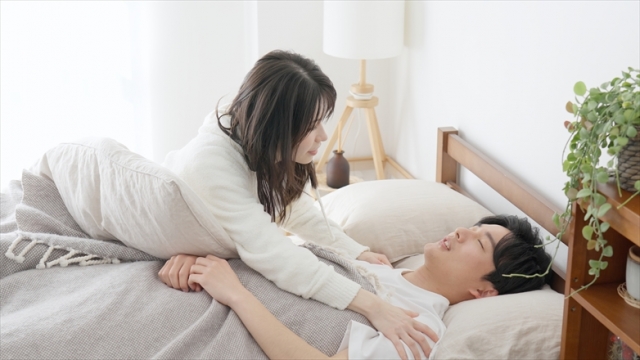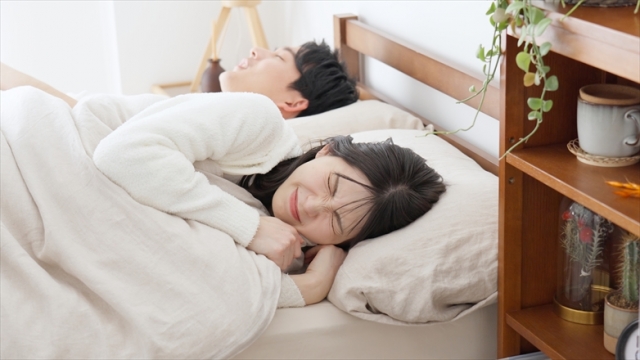

In previous articles, we’ve covered real-life snoring incidents at the dinner table and the effects snoring can have on children.
This time, we look at the problems snoring can create with a bed partner.

In previous articles, we’ve covered real-life snoring incidents at the dinner table and the effects snoring can have on children.
This time, we look at the problems snoring can create with a bed partner.
Kazuyuki Sugaya
Director, Ueno Snoring Clinic / Anesthesiologist
Our director, with over 20,000 general anesthesia cases, focuses primarily on the diagnosis and treatment of snoring and sleep apnea, offering care tailored to each patient. [Insurance-Covered] Ueno Snoring Clinic
This article was reviewed by our Director, Kazuyuki Sugaya, and explains accurate medical information about the testing and treatment of snoring and sleep apnea syndrome (SAS) in clear, accessible terms.
The causes of snoring range from the structure of the throat to body weight. Ueno Snoring Clinic doesn’t rely on a single treatment approach — we’re set up to recommend the best plan for each patient from a broad, evidence-based range of options.
Insurance-Covered: Thorough Testing and Ongoing Treatment
Self-Pay: Address the Root Cause, Short-Term Focus
*As a clinic specializing in snoring treatment, we work to resolve “snoring that won’t stop” through both insurance-covered and self-pay options.
Quick Answer
Snoring is often treated as a personal quirk, but it can seriously affect a couple’s relationship. Night after night of disrupted sleep can lead a couple into separate bedrooms, which reduces everyday physical and emotional closeness and can quietly widen the distance between them. Misunderstanding makes things worse: the person snoring often feels they’re sleeping just fine, while their partner is genuinely suffering — a gap that, left unaddressed, tends to turn into resentment and conflict rather than a solved problem. The healthiest path is to treat snoring as something the couple faces together — with empathy rather than blame — and to consider a medical evaluation, since many cases have a treatable, physical cause.
📋 What This Article Covers
Snoring is often seen as “someone’s own problem” — a quirk or a habit — but in reality, it frequently has a serious effect on the people around the person snoring, and on their relationships.
This is especially true for married couples, dating couples, and anyone sharing a bedroom with a family member: when a sleep environment is shared, snoring can significantly lower everyone’s quality of life.
It’s not unusual for a spouse or partner to say they can’t sleep, or that they keep waking up, night after night, because of snoring. Over time, this can lead a couple into separate bedrooms and less conversation — a kind of “living apart under the same roof,” caused by snoring.
This isn’t just a sleep problem. It can also erode trust and weaken the emotional bond between partners.
A serious gap in perception often opens up between the person who thinks “I’m sleeping fine, so there’s no problem” and the person who is suffering through sleepless nights — and that gap can escalate into real emotional conflict.
Having your sleep disrupted by “sound” is a stress that hits directly at the emotions, and it can affect every part of daily life.
In a very real sense, it functions like a kind of “silent aggression”.
For many couples, nighttime is when the friction of the day is smoothed over — a precious space for connection.
But when the unconscious sound of snoring threatens that space, “restful nights” turn into “nights of endurance.”
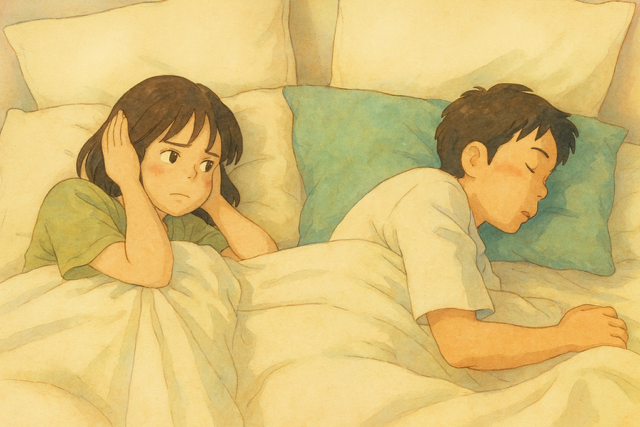
When a partner’s snoring disrupts your sleep, your own sleep quality naturally suffers as well. Being woken repeatedly by the sound, or simply unable to sleep because it’s too loud, leads to ongoing sleep deprivation — and that, in turn, brings fatigue, irritability, reduced concentration, and a weaker immune system. There are also reports linking this kind of chronic sleep disruption to a higher risk of worsening mental health, including depression and anxiety.
Many couples, unable to bear the noise, eventually feel they have no choice but to start sleeping in separate rooms.
Once separate sleeping becomes routine, everyday intimacy — physical closeness, conversation before bed — tends to disappear, and emotional distance can quietly grow. Feelings of loneliness and isolation can build on both sides: one partner may feel guilty about “not being able to sleep together,” while the other feels “abandoned,” each carrying negative feelings the other may not fully see.
This often accelerates a decline in physical intimacy as well, and that physical distance can, in turn, be reflected in emotional distance — a real trigger for a relationship to cool. What starts as “sleeping apart out of necessity” can, without anyone quite intending it, lead to a cooling of the relationship — and in some cases, even to separation or divorce.
The “sound” of snoring can end up building an invisible wall between two people.
In cases where “nothing changes no matter how many times I bring it up” or “they get irritated whenever I mention it,” the issue tends to escalate into outright emotional conflict.
Very often, the person snoring has little awareness of the problem and little intention of addressing it, which can build resentment on the other side — thoughts like “it’s just snoring, why make such a big deal of it” or “maybe you’re just too sensitive” — eventually turning into anger and a sense of hopelessness.
On the other hand, even when the person snoring genuinely feels bad about it, a relationship can still fracture if their partner keeps venting frustration — “how can you feel nothing when I can’t sleep at all?” — without either side finding a way to meet in the middle.
Exchanges like these expose a lack of mutual understanding and empathy, and once built-up frustration finally boils over, the damage can be difficult to undo.
In fact, “snoring” is a recurring theme that comes up in couples counseling and divorce consultations as one of the contributing factors.
The impact of snoring isn’t limited to the emotional side. Reduced sleep quality can lead to daytime sleepiness, poorer work performance, and difficulty concentrating, resulting in chronic fatigue and irritability.
Recent research has also reported cases where a partner’s snoring appears to act as a trigger for depression or anxiety disorders. Sleep disruption and mental health are closely connected, and it’s not hard to see how ongoing, nightly sleep disturbance can take a real toll on both mind and body.
Snoring isn’t simply “one person’s problem” — it’s a real social and domestic issue that directly affects a family’s health and relationships.
If your partner is struggling with snoring, start by listening without dismissing their concern. Since underlying conditions such as sleep apnea syndrome are also possible, it’s worth considering an evaluation at a specialist clinic together.
And if you’re the one snoring, even if you feel you’re sleeping fine yourself, please take a moment to consider what your partner may be sacrificing. Facing the issue honestly, rather than looking away, is what keeps you from becoming an unwitting source of harm.
It might seem like “just snoring.” But it’s not so simple.
During sleep — one of our most vulnerable, unguarded moments — a relationship meant to offer comfort and closeness can instead be threatened by sound.
Snoring carries not only the physical risk of “apnea syndrome,” but also the relationship risk of what might be called a “syndrome of not being understood.”
What we want this article to convey is that snoring is a challenge for the whole household — one that, left unaddressed, can damage both health and relationships. That’s exactly why it’s worth facing together rather than struggling alone, calling on medical or professional support where needed, to restore both “quiet nights” and a “warm relationship.” That, ultimately, is what treating snoring is really about.
For couples in a relationship, snoring can sometimes become an unexpected emotional turning point.
Early in a relationship, everything is often filled with the excitement of getting to know each other. But as a couple spends more nights together, the very practical issue of “sleep compatibility” can surface.
For couples who aren’t yet married, or newlyweds, snoring can be a surprisingly sensitive issue that puts real strain on the relationship. Some describe being caught off guard by a partner’s snoring on their first trip together, and feeling genuinely uneasy about the relationship’s future as a result.
As the relationship progresses and a couple starts living together, it’s common to initially brush it off — “maybe they’re just tired,” “it’s probably just extra loud tonight” — but once it becomes a nightly occurrence, that patience has its limits.
Once snoring becomes an obvious, ongoing issue, many people start to genuinely wonder, “can I really keep living like this?”
Some people simply feel they don’t want to be with a partner who snores, full stop. In other cases, a relationship begins without either person realizing snoring would be an issue, and once they start sharing a bed, the disrupted sleep gradually turns time together into something painful, and the couple starts to drift apart.
The person snoring, too, can lose self-confidence under the pressure of feeling like a burden, becoming quieter and more withdrawn in conversation — a kind of psychological shrinking.
There are real cases of couples who ended a cohabitation, or called off a planned marriage, because of snoring.
For couples thinking about marriage or a shared future, snoring isn’t a small matter at all.
Worries about “a future where we can’t sleep together every night,” or “what will we do about bedrooms once we have kids,” can become genuine obstacles on the path to marriage.
For couples hoping to have children, it’s also worth being aware that snoring has been linked in some cases to male infertility (through reduced sleep quality and hormonal disruption) — a concern that shouldn’t be entirely dismissed when thinking about the future.
At first glance, snoring might seem like a minor issue in a relationship. But in reality, it touches something as fundamental as sleep, and it can have a real effect on deep mutual trust and future life plans.
On the other hand, if a couple can face the issue head-on together, understand one another, and work toward a solution as a team, the relationship can come out even stronger for it.

Looking for a solution together, and moving past any embarrassment to learn about the treatment options available — that kind of effort is, in itself, real evidence of a shared commitment to building a life together.
Whether you can see snoring not simply as an obstacle, but as one more milestone on the path you’re building together, may end up being an important turning point.


English Support Available
We provide medical services for international patients. Please check our English website for details on how to visit our clinic.
Supervising Physician

Kazuyuki Sugaya, Director of Ueno Snoring Clinic
After graduating from Fujita Health University School of Medicine in 2004, Dr. Sugaya began his career as an anesthesiologist at Toho University Omori Medical Center. He has since gained extensive clinical experience at municipal hospitals and private clinics nationwide, administering general anesthesia in over 20,000 cases. In 2020, he founded the "Tokyo Spine Clinic," and has served as the Director of Ueno Snoring Clinic since 2025.
Related Columns
By Appointment Only
Specialized Snoring Treatment in Ueno
Ueno Snoring Clinic
Insurance-covered home testing available.
Following a physician’s consultation and result explanation,
we support the improvement of snoring and sleep apnea with "Dual Deep Thermia"—a non-surgical laser treatment, if necessary.
3-min walk from Ueno Station. Please feel free to consult us.