Ueno Snoring Clinic offers CPAP management under insurance coverage — including priority access to the AirMini — as well as self-pay laser treatment for snoring, tailored to your specific condition. If you’re interested, please start with an initial consultation.
Details of the tests and treatments offered at Ueno Snoring Clinic can be found here
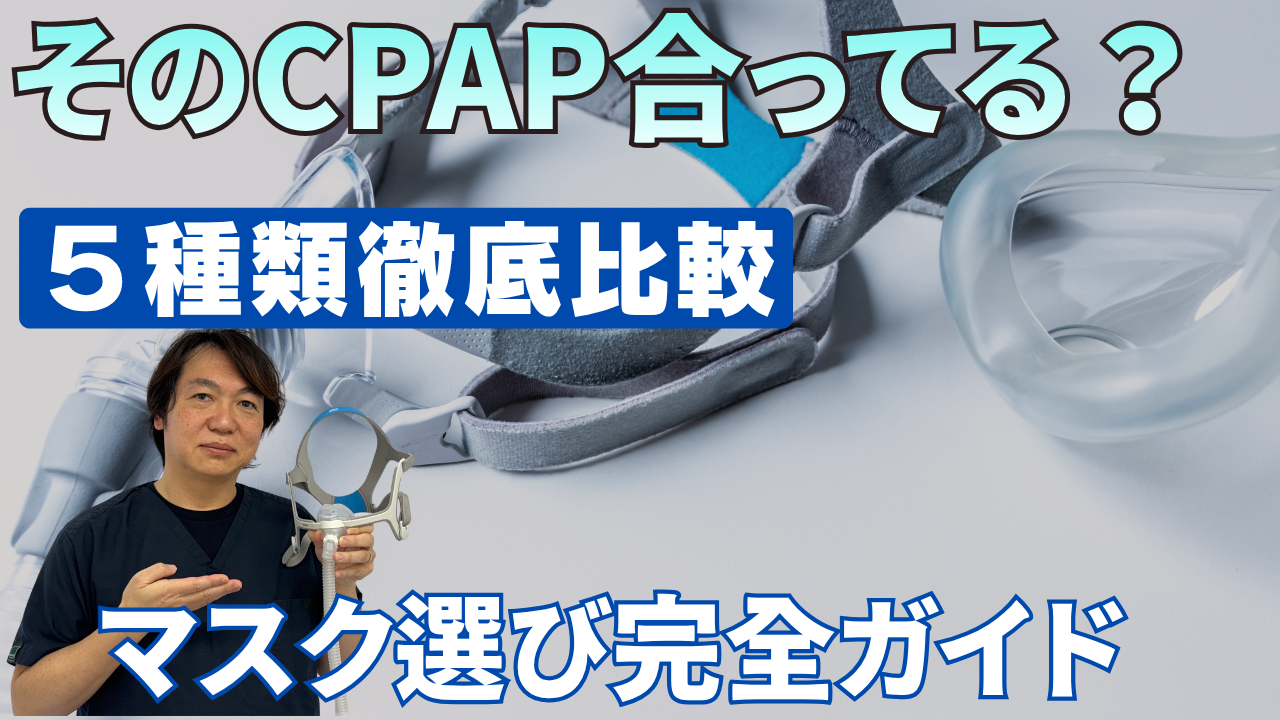
A Complete Comparison of CPAP Masks
We tried on and reviewed five different types of CPAP masks. 90% of CPAP comfort comes down to the mask.
Watch the video
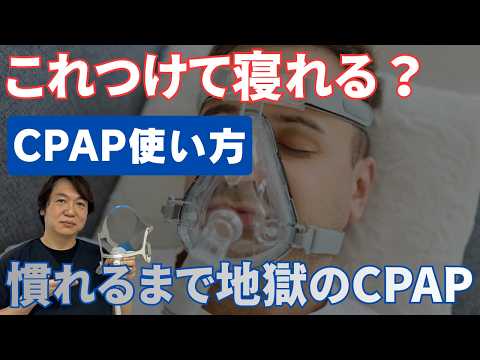
Do you have to use CPAP forever? A specialist explains how to use CPAP
A detailed explanation of how to use CPAP, with a real demonstration of what it feels like to wear the device.
Watch the video
Ueno Snoring Clinic was featured on Fuji TV’s “Live News It!” and on FNN Prime Online
Watch our clinic’s examination and explanation of sleep disorders, snoring, and sleep apnea.
Watch the video
Ueno Snoring Clinic was featured in an article on Nippon TV’s “news every.”
Please take a look as a starting point for thinking about getting evaluated for snoring, sleep apnea, or other sleep disorders.
Read the article
Reviewed by Our Director
Kazuyuki Sugaya
Director, Ueno Snoring Clinic / Anesthesiologist
Our director, with over 20,000 general anesthesia cases, focuses primarily on the diagnosis and treatment of snoring and sleep apnea, offering care tailored to each patient. [Insurance-Covered] Ueno Snoring Clinic
This article was reviewed by our Director, Kazuyuki Sugaya, and compares the size, features, and disaster-readiness of the ResMed AirMini and AirSense 11 using photos of the actual devices, so patients can make an informed decision about which CPAP setup is right for them.
🩺Comprehensive Snoring Treatment at Ueno Snoring Clinic
Ueno Snoring Clinic is set up to recommend the best plan for each patient’s situation, from CPAP management — including priority access to the AirMini — through to laser treatment.
Insurance-Covered: Thorough Testing and Ongoing Treatment
- Simplified and PSG testing: A precise analysis of your sleep condition
- CPAP treatment: Compatible with models including AirMini and AirSense 11
Self-Pay: Address the Root Cause, Short-Term Focus
- Snoring laser treatment: A non-surgical approach to the underlying cause
- Medically supervised weight loss: Improving airway space through weight reduction
*As a clinic specializing in snoring treatment, we work to resolve “snoring that won’t stop” through both insurance-covered and self-pay options.
Our director’s book, “Curing Snoring with the Latest Treatments” (No.1 Amazon Bestseller in General Medicine, No.1 in Clinical Internal Medicine, No.2 in Home Medicine & Health) covers this topic in detail as well
New Book by Our Director
“Curing Snoring with the Latest Treatments”
A guide to the latest snoring treatments, written by an anesthesiologist who has overseen the sleep of more than 10,000 patients.
View on Amazon
Quick Answer
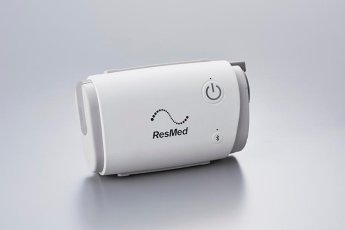
The AirMini is close to the size of an iPhone and fits entirely into its own carrying case, making it far more portable for travel, business trips, and evacuations. The AirSense 11, by comparison, offers a built-in humidifier, a large display, and broader mask compatibility. A practical setup is to keep the AirSense 11 as your everyday home unit and add the AirMini as a backup for disaster preparedness — and Ueno Snoring Clinic has priority access to help you obtain one.
📋 What This Article Covers
- AirMini vs. AirSense 11 size comparison (with in-clinic photos)
- Detailed feature and spec comparison of the two models
- Why the Kumamoto earthquake put AirMini in the spotlight — its advantages for disaster and evacuation use
- AirMini’s weak points and things to watch for
- Which one should you choose? Recommendations by use case
- Obtaining an AirMini at Ueno Snoring Clinic
Size Comparison in Photos: AirMini vs. AirSense 11
First, take a look at the actual size difference in these photos. All of the devices shown were photographed in our clinic.
▼ The AirMini fits entirely into its own carrying case
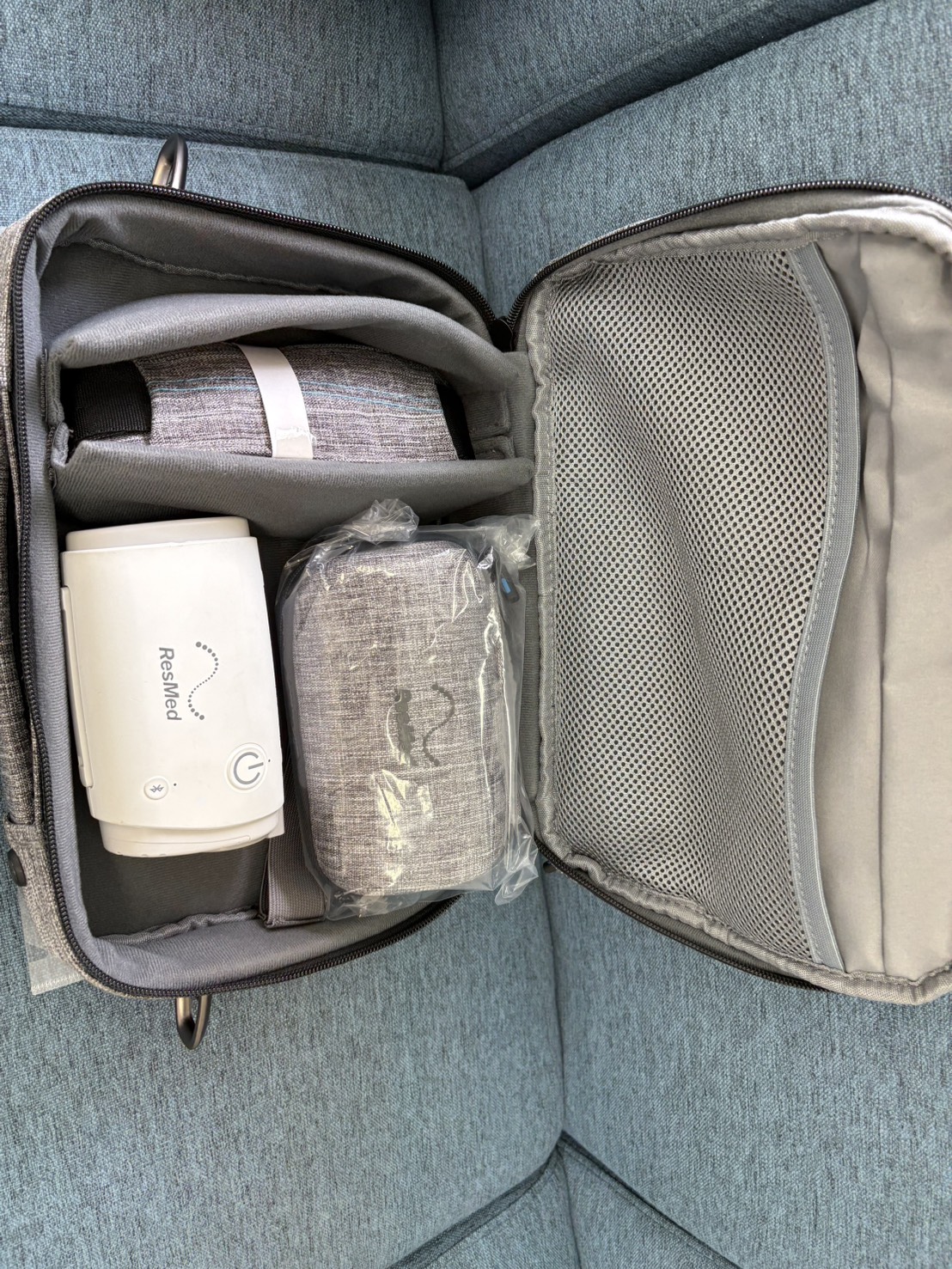
The main unit, mask, tubing, and power adapter all fit into this single carrying case — compact enough to pack straight into an emergency go-bag.
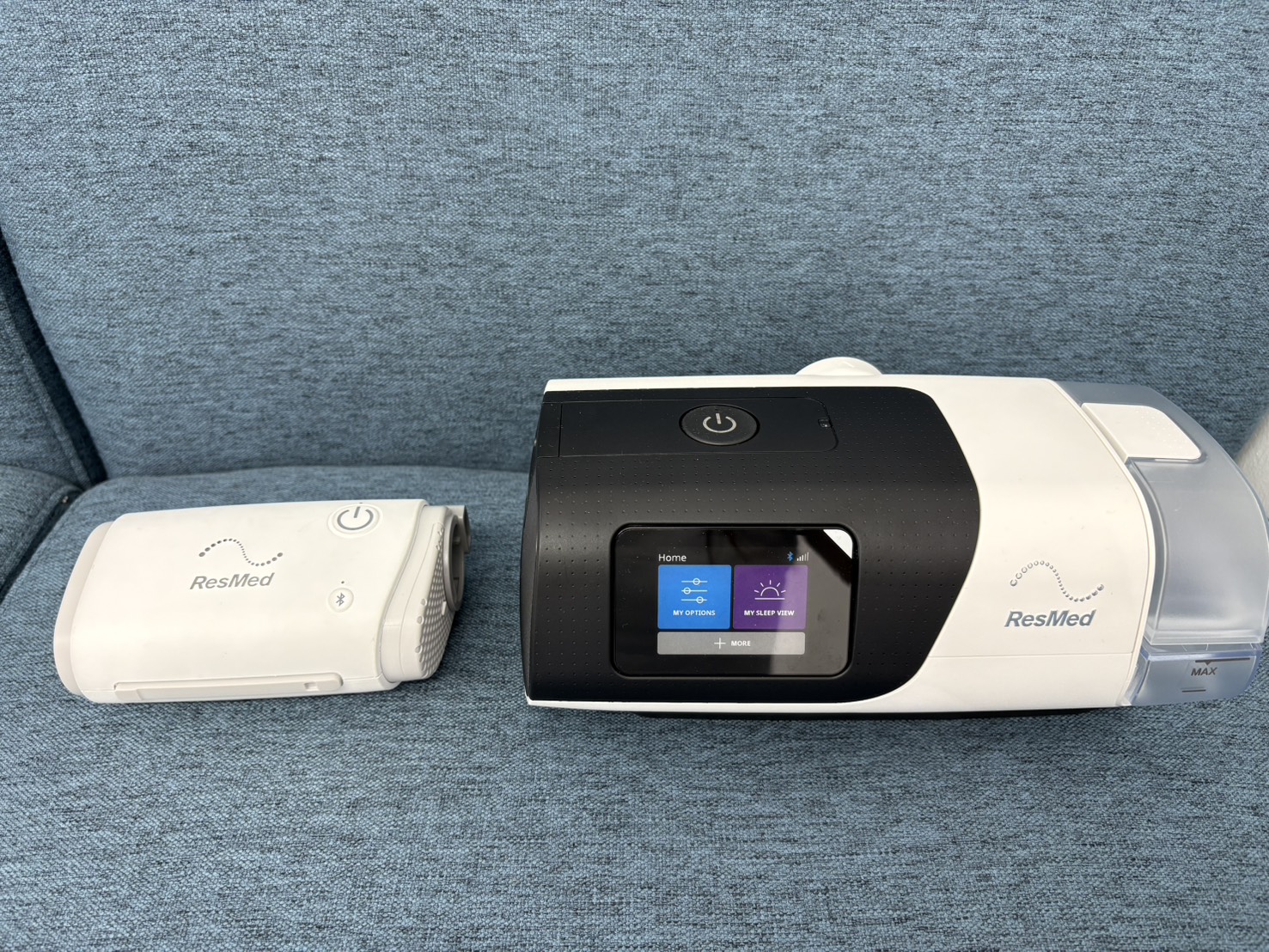
▼ AirMini (left) and AirSense 11 (right) side by side
▼ AirSense 11 (top) and AirMini (bottom) stacked for comparison
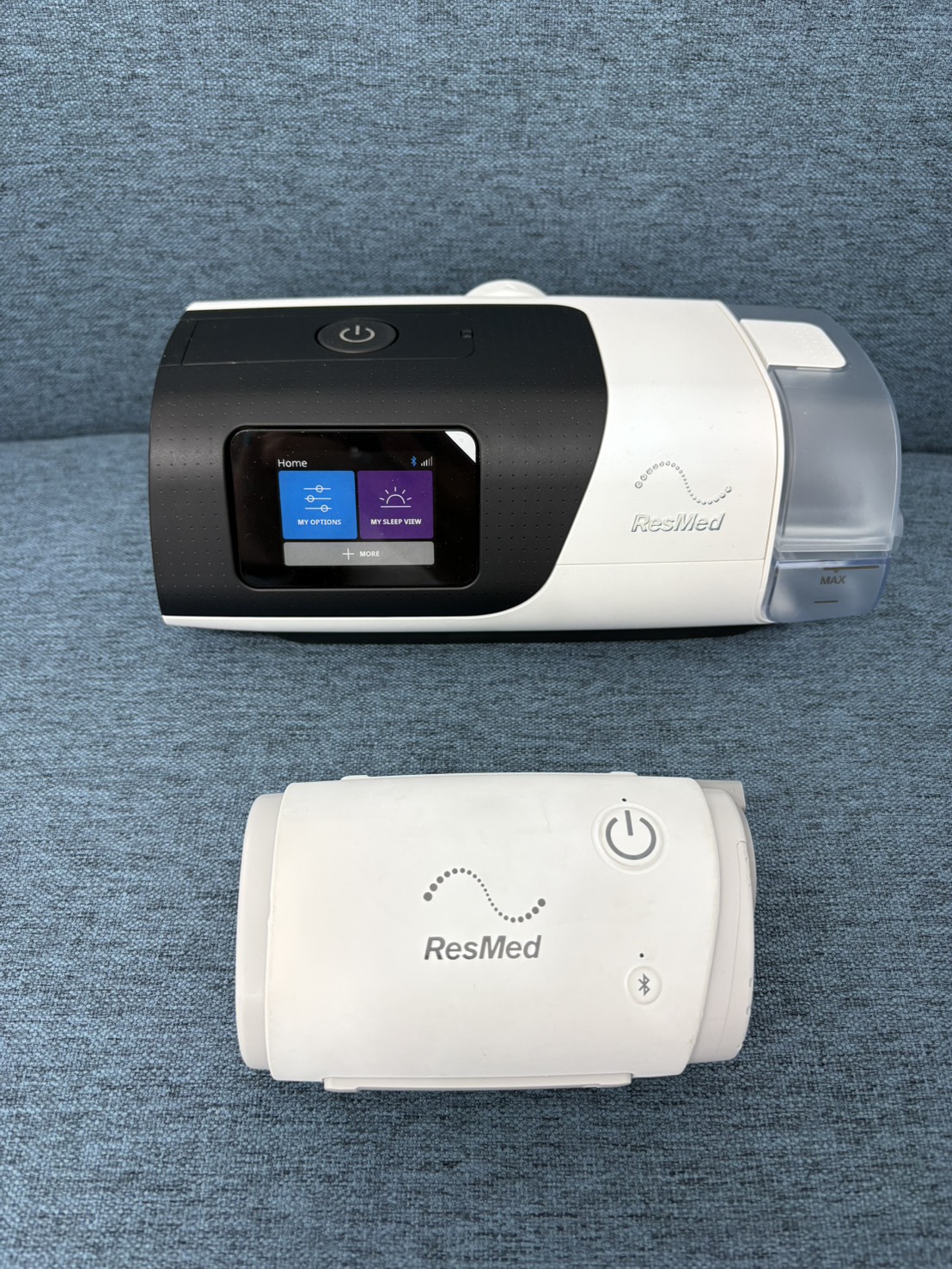
The AirSense 11 is a standard tabletop CPAP with a touchscreen display and a built-in humidifier. The AirMini packs the same core function into roughly a third of the size or less.
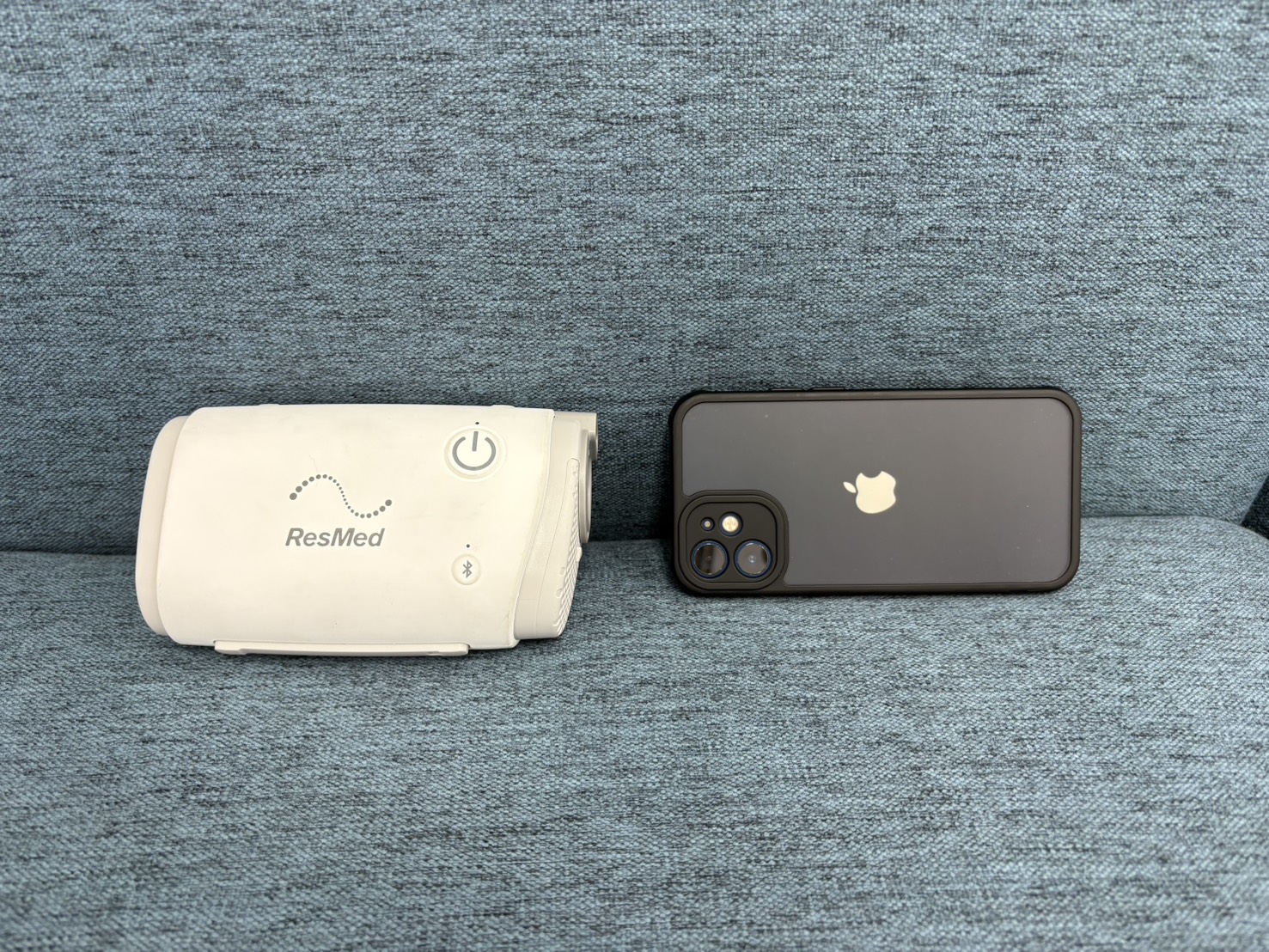
▼ AirMini next to an iPhone for scale (front and side view)
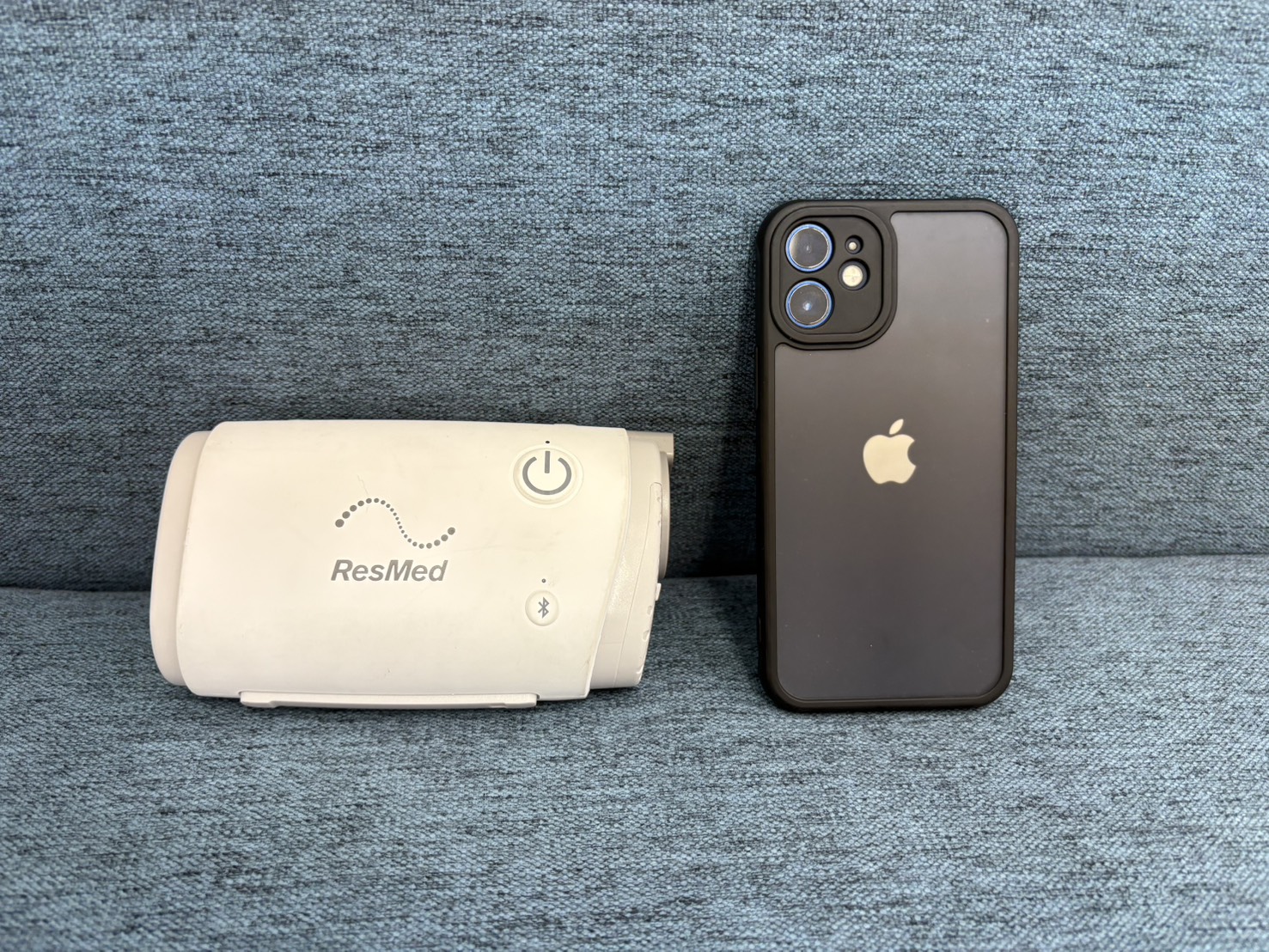 The AirMini has almost the same footprint as an iPhone. If you can carry a smartphone with you, you can carry a CPAP.
AirMini vs. AirSense 11: Full Feature and Spec Comparison
| Feature |
AirMini |
AirSense 11 |
| Size |
Palm-sized
~13.6 × 8.4 × 5.2 cm |
Standard tabletop size
~27.2 × 11.5 × 15.7 cm |
| Weight |
~300g (excluding mask) |
~1.3kg (excluding water tank) |
| Humidification |
Mask-integrated HumidX™
(no water tank needed) |
Built-in humidifier
(with water tank) |
| Display |
None (managed via app) |
Full-color touchscreen |
| Controls |
myAir app (smartphone) |
Touchscreen + app |
| Mask compatibility |
AirFit N20, F20, P10
(requires a dedicated connector) |
Broad compatibility with ResMed masks |
| Power draw (approx.) |
~30W (without humidification) |
~60–90W (with humidifier) |
| Compatibility with portable power |
◎ A 300Wh-class unit covers a full night or more |
△ Needs 600Wh or more |
| In-flight carry-on |
✅ Permitted (FAA-approved) |
Depends on model and airline |
| Dedicated carrying case |
✅ Included (fits all accessories) |
Must be purchased separately |
| Best suited for |
Travel, business trips, evacuations, backup unit |
Primary home use, long-term stability |
Why the Kumamoto Earthquake Put AirMini in the Spotlight: Its Advantages for Disaster and Evacuation Use
Since the July 2025 earthquake in Kumamoto, we’ve heard a growing number of patients say things like “I couldn’t bring my CPAP when I evacuated” or “the power outage meant I couldn’t use my CPAP” — and inquiries about the AirMini have risen sharply as a result. There are three main reasons the AirMini stands out in a disaster-preparedness context.
🎒 Easy to grab and go
Nearly the same size as an iPhone at around 300g, everything fits into its own carrying case. It’s the one CPAP that realistically fits into an emergency go-bag.
🔋 Runs on very little power
At around 30W of power draw, a 300Wh-class portable power station can run it for a full night or more — a clear advantage over the AirSense 11 when it comes to power.
💧 No water tank needed
Humidification comes from the mask-integrated HumidX™, so no water tank is required — a real advantage when clean water is hard to come by during an evacuation.
📌 Advice From Our Clinic
One of the most practical approaches to power-outage preparedness right now is to keep the AirSense 11 as your everyday unit at home, while keeping the AirMini on hand as a backup for disaster preparedness and travel. If you’re interested in adding an AirMini alongside your insurance-covered CPAP, please feel free to ask us.
AirMini’s Weak Points: An Honest Look at the Downsides
The AirMini is compact and capable, but it isn’t the right fit for everyone. Here are the things worth knowing before you switch.
| Consideration |
Details |
| Limited mask compatibility |
Requires a dedicated connector for AirFit N20, F20, or P10 masks — if your current mask isn’t one of these, you’ll need to switch |
| No on-device display |
All data checks and settings changes happen through the smartphone app, which can be inconvenient for those less comfortable with smartphones |
| Slightly weaker humidification |
HumidX™ provides less humidity than a water-tank system, which may feel insufficient in especially dry seasons or regions |
| Can be hard to obtain |
Demand has surged since the Kumamoto earthquake and stock is tight, with many general clinics facing backorders |
Which One Should You Choose? Recommendations by Use Case
| If this describes you or your use case… |
AirMini |
AirSense 11 |
| You want stable, everyday use at home |
△ |
◎ |
| You want to carry it on business trips or travel |
◎ |
△ |
| You want to prepare for power outages from earthquakes or typhoons |
◎ |
× |
| You want to run it overnight on a small portable power station |
◎ |
△ |
| You rely on strong humidification and can’t do without it |
△ |
◎ |
| You want to check your data easily through an app |
◎ |
◎ |
Obtaining an AirMini at Ueno Snoring Clinic
Since the Kumamoto earthquake, demand for the AirMini has risen sharply, and many clinics are facing supply shortages and waitlists. Ueno Snoring Clinic has a priority supply relationship with the manufacturer, so in most cases we’re able to provide one to patients who would like one.
The AirMini is covered by insurance as a CPAP device, but as with any CPAP, it’s prescribed following an examination and testing at our sleep specialty clinic. If you’re currently using CPAP through another clinic, we’re also happy to discuss switching to our care.
✅ How AirMini Introduction Works at Our Clinic
- Initial consultation (review of your current CPAP use and mask type)
- Confirming AirMini suitability based on your sleep data and clinical findings
- Selecting a compatible mask (N20, F20, or P10)
- Introducing the AirMini, with guidance on usage and app setup
Whether you’d like to add a backup unit for disaster preparedness or switch to a CPAP you can bring on trips and business travel, we’re happy to help either way. Please feel free to reach out for a consultation.
Summary
The AirMini is a compact CPAP that’s nearly the same size as an iPhone, weighs around 300g, and fits entirely into its own carrying case. It draws very little power, pairs well with portable power stations, and offers outstanding portability for travel, business trips, and disaster preparedness alike.
The AirSense 11, on the other hand, offers a built-in humidifier, a large touchscreen display, and broad mask compatibility — ideal for comfortable, stable, long-term use at home. Right now, one of the smartest setups is keeping the AirSense 11 at home while using the AirMini for disaster preparedness and travel.
Since the Kumamoto earthquake, the AirMini has remained difficult to obtain at many general clinics. We have priority access to supply, so if you’re interested, we’d recommend reaching out sooner rather than later.
Questions About the AirMini? Contact Us
Whether you’d like to switch from your current CPAP, add an AirMini as a backup for disaster preparedness, or start CPAP for the first time, we’re happy to help. Please contact us to check current availability.
Concerned About Snoring or Sleep Apnea?
Even if you’ve never used CPAP before, you can start with an at-home sleep test. Fully insurance-covered, fully appointment-based, with same-day appointments available.
Frequently Asked Questions
Q. I currently use the AirSense 11 — can I switch to the AirMini?
A. Switching is possible, but we’d first need to confirm whether your current mask is AirMini-compatible (AirFit N20, F20, or P10). Since it also requires updating your insurance prescription, please start with a consultation.
Q. Is the AirMini covered by insurance?
A. Yes, it’s covered by insurance as a CPAP device. That said, insurance-covered CPAP prescriptions require a sleep study and meeting certain criteria (for example, an AHI of 15 or higher on a PSG test). If you’re currently prescribed CPAP at another clinic, we can also help with switching your care to us.
Q. When can I actually get an AirMini? What’s the current availability?
A. Availability varies over time. We maintain a priority supply channel with the manufacturer, but this can still fluctuate with demand. The most reliable way to check current stock is to contact us by LINE or phone.
Q. Can I get an AirMini purely as a backup for disaster preparedness?
A. Insurance-covered CPAP prescriptions are based on a doctor’s examination and testing. Even if your main interest is disaster preparedness, we’ll first need to assess your condition through a consultation before we can advise further. We’re happy to talk it through with you either way.






いびきを最新治療で治す-表紙-1.png)