Ueno Snoring Clinic offers insurance-covered CPAP introduction and management, and we’re also happy to advise patients who travel frequently on choosing the right model. If you have any concerns about traveling with CPAP, please don’t hesitate to bring them up at your next visit.
Details of the tests and treatments offered at Ueno Snoring Clinic can be found here
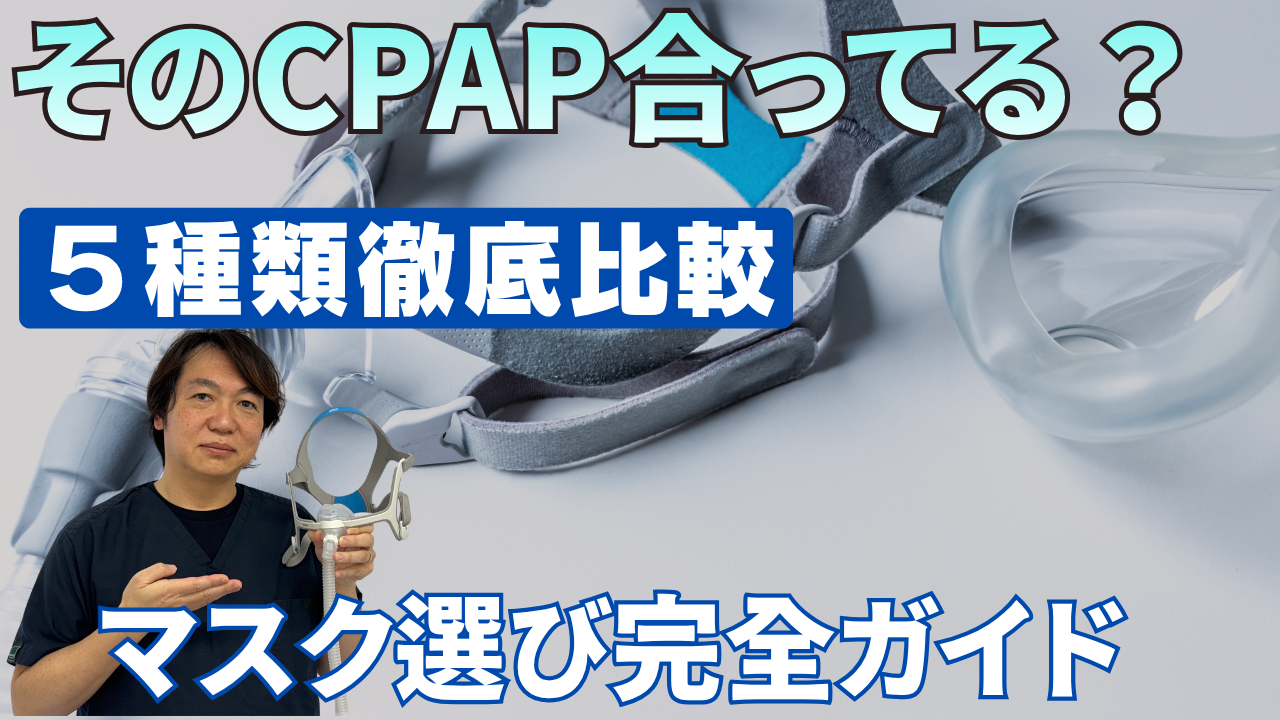
A Complete Comparison of CPAP Masks
We tried on and reviewed five different types of CPAP masks. 90% of CPAP comfort comes down to the mask.
Watch the video
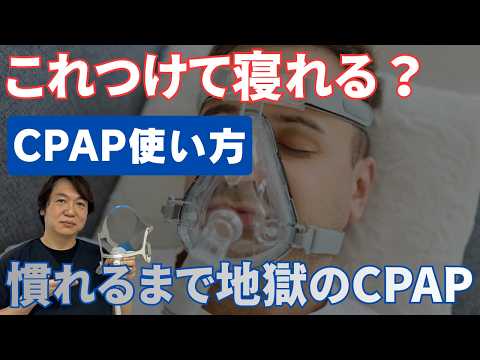
Do you have to use CPAP forever? A specialist explains how to use CPAP
A detailed explanation of how to use CPAP, with a real demonstration of what it feels like to wear the device.
Watch the video
Ueno Snoring Clinic was featured on Fuji TV’s “Live News It!”
Watch our clinic’s examination and explanation of sleep disorders, snoring, and sleep apnea.
Watch the video
Ueno Snoring Clinic was featured in an article on Nippon TV’s “news every.”
Please take a look as a starting point for thinking about getting evaluated for snoring, sleep apnea, or other sleep disorders.
Read the article
Reviewed by Our Director
Kazuyuki Sugaya
Director, Ueno Snoring Clinic / Anesthesiologist
Our director, with over 20,000 general anesthesia cases, focuses primarily on the diagnosis and treatment of snoring and sleep apnea, offering care tailored to each patient. [Insurance-Covered] Ueno Snoring Clinic
This article was reviewed by our Director, Kazuyuki Sugaya, and draws on his own experience to explain what CPAP users should know about carry-on rules, overseas power compatibility, and hotel considerations when traveling for business or leisure.
🩺Comprehensive Snoring Treatment at Ueno Snoring Clinic
Ueno Snoring Clinic provides insurance-covered CPAP introduction and management, and we’re also glad to advise patients who travel frequently on model selection and travel accessories.
Insurance-Covered: Thorough Testing and Ongoing Treatment
- Simplified and PSG testing: A precise evaluation of the underlying causes of snoring and apnea
- CPAP treatment: The standard treatment for moderate-to-severe apnea
Self-Pay: Address the Root Cause, Short-Term Focus
- Snoring laser treatment: Available in 3-, 6-, and 12-session packages
- Medically supervised weight loss: An option when weight gain is a contributing factor
*We’re happy to discuss CPAP model selection and travel accessories at your regular visits.
Our director’s book, “Curing Snoring with the Latest Treatments” (No.1 Amazon Bestseller in General Medicine, No.1 in Clinical Internal Medicine, No.2 in Home Medicine & Health) covers this topic in detail as well
New Book by Our Director
“Curing Snoring with the Latest Treatments”
A guide to the latest snoring treatments, written by an anesthesiologist who has overseen the sleep of more than 10,000 patients.
View on Amazon
Quick Answer
As medical equipment, CPAP can be carried onto both domestic and international flights. For domestic flights (JAL/ANA), a doctor’s letter or advance notice isn’t mandatory, but you’ll need to contact the airline’s dedicated desk before booking if you plan to use in-flight power. On international flights, some airlines may ask for an English-language medical letter or manufacturer information in advance, so it’s worth checking beforehand. For travel abroad, most CPAP models automatically support 100–240V, so a voltage converter isn’t needed — a plug shape adapter is usually enough. A compact travel CPAP like the “AirMini” is convenient for trips. This same kind of power preparation also applies directly to being ready for a power outage during a disaster.
📋 What This Article Covers
- Quick answer: CPAP can be carried on both domestic and international flights
- Carrying CPAP on domestic flights (JAL/ANA)
- What to know when carrying CPAP on international flights
- Basic carry-on rules and how to think about batteries
- Overseas voltage and plugs — do you need a converter?
- Why “AirMini” is a good choice for a travel CPAP
- What to watch for using CPAP at a hotel
- Bonus: the same preparation helps with disaster power outages, too
Quick Answer: CPAP Can Be Carried on Both Domestic and International Flights
CPAP is a treatment-related piece of medical equipment and is recognized as permitted carry-on baggage. On both domestic and international flights, the basic rule is to always carry it on as hand luggage rather than checking it. Checked baggage carries a risk of damage or loss, and isn’t well suited to a precision device like CPAP.
A doctor’s letter or medical certificate isn’t universally required, but if you want to use in-flight power, or you’re bringing a larger model, advance contact with the airline may be necessary. Rather than worrying over whether you can bring it at all, it’s reassuring to first check your specific airline’s policy on medical equipment.
In the next sections, we’ll walk through the specific procedures for domestic and international flights.
Carrying CPAP on Domestic Flights (JAL/ANA)
On domestic flights, both JAL and ANA generally allow CPAP to be carried on board as medical equipment, and a doctor’s letter or advance notification isn’t universally required. That said, advance consultation is recommended if you’d like to use power at your seat, or depending on your specific model.
On ANA, CPAP is listed as the only medical device that can use the in-seat power supply, and it can be used except during takeoff, landing, taxiing, and while parked (the humidifier function cannot be used in flight). If you plan to use seat power, it helps to contact the “Accessibility Desk” before booking with your device’s model name, manufacturer, part number, and battery type.
If you’re bringing your own battery, airlines generally advise preparing enough capacity to cover roughly 150% of your flight time. For larger devices that won’t fit in the seat’s storage space, purchasing an additional seat may sometimes be necessary.
Personally, even on short domestic flights where advance notice isn’t required, I always bring a fully charged battery, and I make a point of self-declaring “this is a CPAP, a medical device” at security. That alone tends to keep the screening process moving smoothly.
✈️ JAL vs. ANA: CPAP In-Flight Power at a Glance
| Item |
ANA |
JAL |
| Doctor’s letter required? |
Not mandatory |
Not mandatory |
| In-seat power |
Only approved medical device |
Case-by-case; check in advance |
| Advance contact |
Recommended (Accessibility Desk) |
Recommended for power use |
| Power during takeoff/landing |
Not available on either airline |
*Policies can change — always confirm current details directly with the airline before your trip.
What to Know When Carrying CPAP on International Flights
International flights require more caution than domestic ones, since policies vary more widely between airlines. Most airlines recognize CPAP as permitted medical equipment for carry-on, but some airlines may require an English-language medical letter (a “travel letter”), manufacturer information, or the model name, part number, and battery capacity to be submitted in advance.
Some airlines operating long-haul international routes may request advance notification up to 72 hours before boarding, so we’d recommend checking the airline’s official website for its medical-equipment policy one to two weeks before departure. Having your doctor prepare an English-language letter (noting that you use CPAP, the model name, and a summary of your condition) also brings peace of mind at security checks abroad.
At the security checkpoint, the standard approach is to place the CPAP unit alone in a tray and self-declare, “This is medical equipment — a CPAP.” Being able to show an English-language manual or letter helps the check go smoothly. Keeping your battery and AC adapter somewhere easy to reach also helps you avoid scrambling during the check.
🌍 International Flight Prep Checklist
| ✅ |
Check the airline’s medical-equipment policy 1–2 weeks before departure |
| ✅ |
Ask your doctor for an English-language letter noting your CPAP use and condition |
| ✅ |
Confirm whether advance notice (up to 72 hrs) is required for long-haul routes |
| ✅ |
Keep your battery, AC adapter, and letter within easy reach for security |
Basic Carry-On Rules and How to Think About Batteries
CPAP’s lithium-ion battery is treated by most airlines as “carry-on only — not permitted in checked baggage.” This isn’t specific to CPAP batteries — it’s a rule that applies to portable batteries in general. If you’re bringing a spare battery, always pack it in your carry-on.
Regarding in-flight power use, even on flights with an outlet at your seat, you generally can’t use it during takeoff, landing, taxiing, or while parked — this applies to both domestic and international flights. Since you won’t be using CPAP during these periods, and power availability won’t cover the entire flight, it’s reassuring to keep some margin in your battery capacity.
150%
Rule of thumb: pack enough battery capacity to cover about 150% of your scheduled flight time — power isn’t available during takeoff, landing, taxiing, or while parked, so build in a margin.
The heater function of a humidifier is generally not usable, or not recommended, in flight. Using CPAP without humidification for a short period usually isn’t a major issue, but if dryness bothers you, many people manage it with moisturizing cream or by adjusting the mask.
Overseas Voltage and Plugs — Do You Need a Converter?
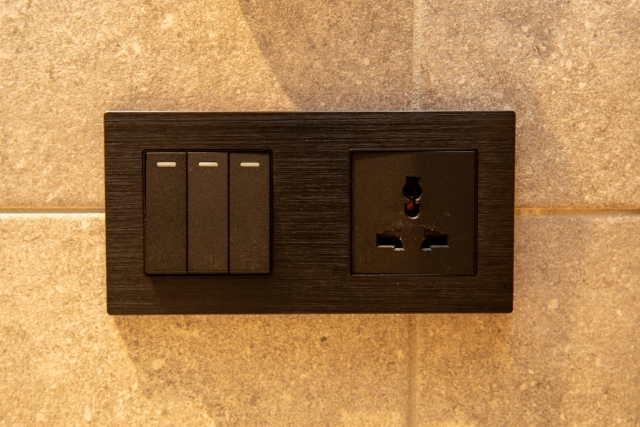
A common worry when traveling abroad is whether CPAP might be damaged by a different voltage. The short answer: most CPAP models currently sold use a “multi-voltage” power supply that automatically switches within the 100–240V range. Check the input voltage (INPUT) label on the unit or its AC adapter — if it shows something like “100–240V,” a voltage converter is generally unnecessary.
What you will need is a plug adapter to match the outlet shape. Since plug shapes vary by destination (Type A, BF, C, SE, and others), it’s reassuring to check the plug shape for your destination beforehand and bring a multi-adapter that covers several shapes. Some humidifier heater components may have a different supported voltage than the main unit, so it’s worth double-checking the manual just in case.
Personally, when I travel internationally, I skip the voltage converter altogether and just bring a compact plug adapter. Being able to cut down on luggage that way is a small but genuinely helpful convenience.
Why “AirMini” Is a Good Choice for a Travel CPAP
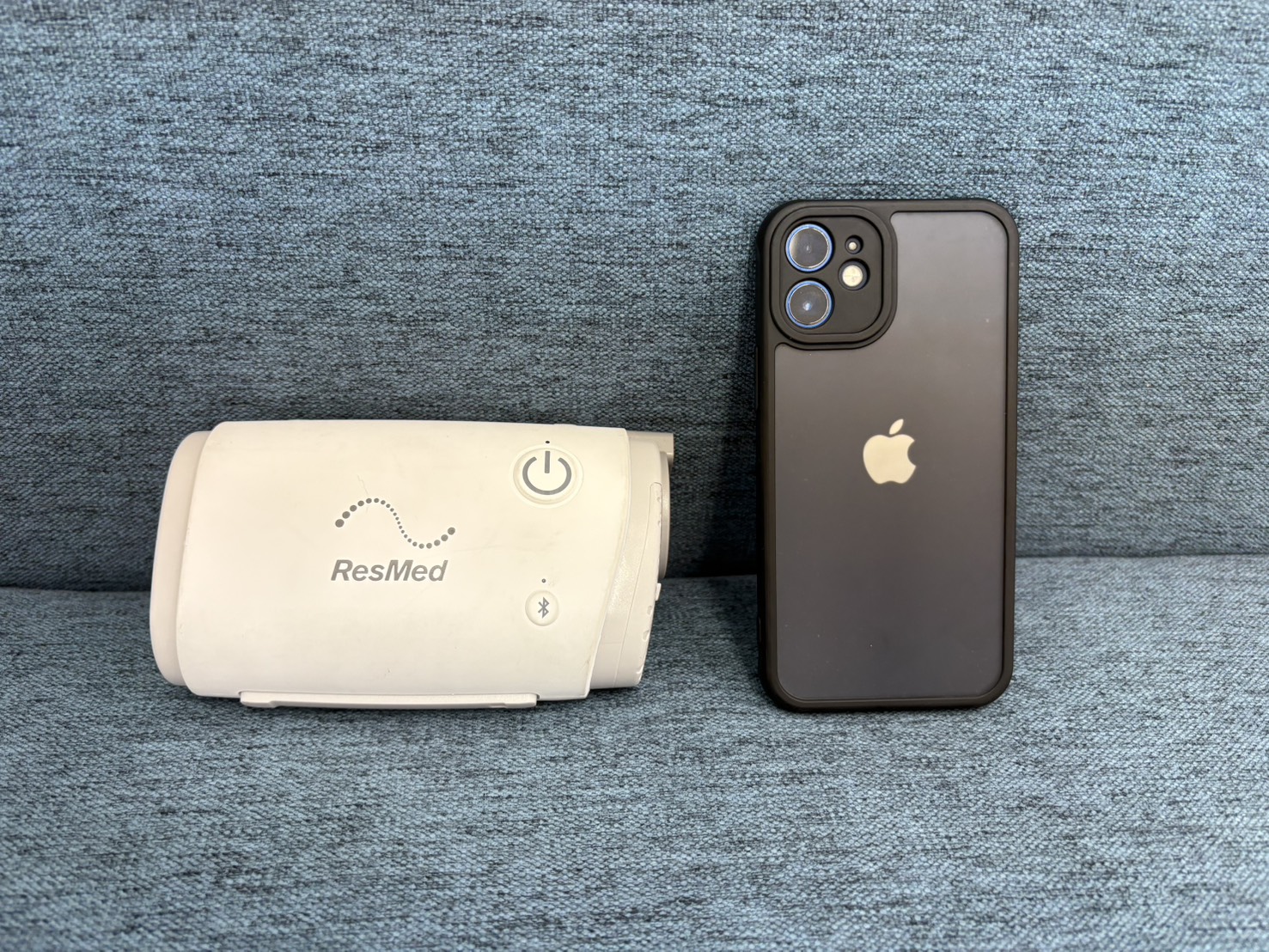
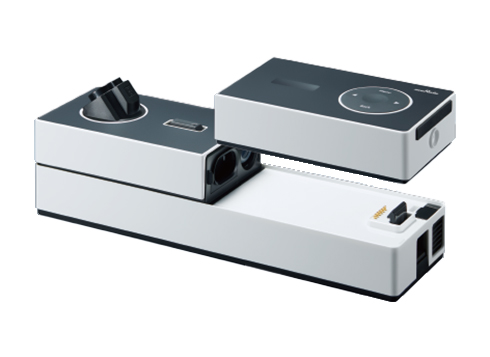
Carrying your everyday CPAP unit around inevitably takes up space. For those who travel or take business trips frequently, a travel-sized CPAP like ResMed’s “AirMini” is worth considering. The AirMini measures roughly 13.6cm x 8.4cm x 5.3cm and weighs about 300g — just a bit larger than a smartphone — making it easy to fit into a carry-on bag.
Its power supply supports 100–240VAC, so it can be used abroad without a voltage converter. It also uses a waterless humidification system called “HumidX,” which is relatively convenient in flight or in dry environments. Many units also run quietly, which can be a thoughtful consideration if you’re sharing a hotel room.
📐 AirMini at a Glance
💧
HumidX
Waterless humidification
🔌
100–240VAC
Voltage support
That said, travel CPAPs like the AirMini can differ from your home unit in pressure range or mask compatibility, depending on the model. Before switching, we’d recommend checking with your doctor or equipment provider whether it’s compatible with your current model and prescribed pressure. Ueno Snoring Clinic is happy to advise on introducing a travel CPAP as well.
What to Watch for Using CPAP at a Hotel
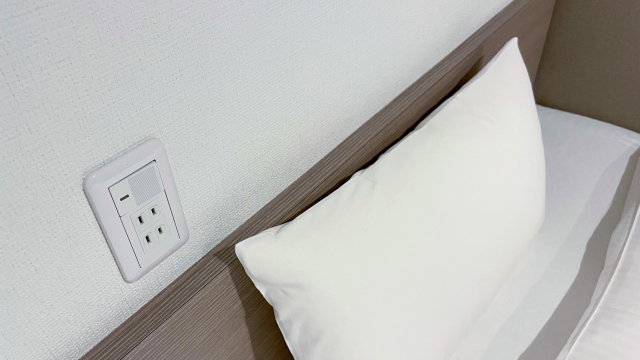
The first thing to check when using CPAP at a hotel is whether there’s an outlet near the bed. Especially at hotels abroad, it’s not unusual for the only outlet to be located far from the bed. Bringing a single extension cord gives you more flexibility in setup and peace of mind.
If you use a humidifier, we’d recommend using bottled or distilled water rather than tap water when traveling abroad. Water quality varies by region, and minerals can build up inside the humidifier more easily in some areas. Using bottled water purchased in-flight, or picking some up at a convenience store or supermarket the day before, works well.
Some accommodations also have a limited number of outlets. Bringing a small power strip helps avoid having to choose between charging your phone and running your CPAP. I personally keep a small power strip with an extension cord in my travel pouch whenever I’m on a business trip.
🧳 Hotel CPAP Packing Checklist
| 🔌 |
Extension cord (for outlets far from the bed) |
| 🔀 |
Compact power strip (to share outlets with your phone charger) |
| 💧 |
Bottled or distilled water for the humidifier (overseas) |
| 🔄 |
Plug adapter matched to your destination’s outlet shape |
Bonus: The Same Preparation Helps With Disaster Power Outages, Too
We’ve focused on travel so far, but the mindset of “how do I keep using CPAP without a guaranteed power source” applies directly to preparing for a power outage during a disaster. If a power outage occurs due to an earthquake, typhoon, or similar event, CPAP won’t function without power, which is why it’s important to keep a portable power source or battery on hand as everyday preparedness.
A battery or portable power source you’ve prepared for travel can double as an emergency power source in a disaster. Likewise, a portable power source you’ve bought for disaster preparedness can also come along on trips — letting you cover both needs without adding extra luggage.
If a power outage would stop your CPAP, we cover how to choose a portable power source and the capacity you’d need in a companion article on our Japanese-language site.
Checking your battery before a trip doubles as a good moment to review your disaster preparedness. Making a habit of checking, a few times a year around travel or business trips, whether your battery charges properly and has enough capacity is a reassuring routine to build.
What Ueno Snoring Clinic Offers
Ueno Snoring Clinic is a Sleep Disorder Medicine clinic specializing in snoring and sleep apnea syndrome. CPAP treatment doesn’t end once it’s started — for patients whose lifestyle involves frequent travel or business trips, we offer ongoing support, including model selection and travel accessory recommendations.
If you travel often for work and feel uneasy about carrying CPAP, are interested in switching to a travel model like the AirMini, or are concerned about managing CPAP after an overseas relocation, please feel free to bring it up at your next visit.
Summary: With the Right Preparation, CPAP Doesn’t Have to Get in the Way of Travel
As medical equipment, CPAP can be carried on both domestic and international flights. Domestic flights don’t require advance notice as a rule, though it’s reassuring to contact the airline ahead of time if you plan to use in-flight power; on international flights, some airlines may ask for documentation like a medical letter. As for overseas voltage, most models support 100–240V, so a converter isn’t needed — a plug adapter is enough.
If you have an upcoming trip or travel frequently for work, it helps to add checking your airline’s policy, charging and checking your battery capacity, and preparing a plug adapter to your pre-trip checklist. We hope you can keep up with your CPAP treatment while still fully enjoying your travel and business trips.
Have Questions About CPAP Models or Traveling With CPAP?
We’re happy to discuss switching to a travel CPAP or how to manage carrying it on business trips. Feel free to reach out any time.
Start With an Initial Consultation
From starting and maintaining CPAP treatment to model selection, we’re here to help with all of it. Fully appointment-based, with same-day appointments available.
Frequently Asked Questions
Q. Do I need a doctor’s letter to bring CPAP on a flight?
A. It’s not universally required on domestic flights. However, some international airlines may ask for an English-language medical letter or manufacturer information, so we’d recommend checking with your airline in advance.
Q. Can I put CPAP in checked baggage?
A. We wouldn’t recommend it. It’s a precision device with a risk of damage or loss, so please always carry it on as hand luggage. Batteries cannot be checked either.
Q. Can I use CPAP during the flight?
A. Some airlines and seats offer in-seat power, but it can’t be used during takeoff, landing, taxiing, or while parked. Checking with the airline in advance and bringing a battery with enough capacity is reassuring.
Q. Do I need a voltage converter for overseas travel?
A. In most cases, no — many CPAP models automatically support 100–240V. Check the input voltage listed on the unit or AC adapter, and bring a plug adapter matched to your destination.
Q. Should I switch to a travel CPAP like AirMini?
A. It’s worth considering if you travel or take business trips frequently. That said, pressure settings and mask compatibility can differ from your home unit, so please check with your doctor or equipment provider before switching.
Q. Is it okay to use tap water for the humidifier at a hotel?
A. When traveling abroad, we’d recommend using bottled or distilled water because of differences in water quality. If you’re concerned about it domestically too, purified water is a safe choice.
Q. Does a CPAP battery also help during a disaster power outage?
A. Yes. A portable power source or battery you’ve prepared for travel can also serve as an emergency power source during an outage.








いびきを最新治療で治す-表紙-1.png)