



いびきを最新治療で治す-表紙-1.png)
The Soft Palate and Snoring: Where the Sound Comes From and Why It Loosens
Dental Alignment & Snoring: The Real Link | Ueno Snoring Clinic
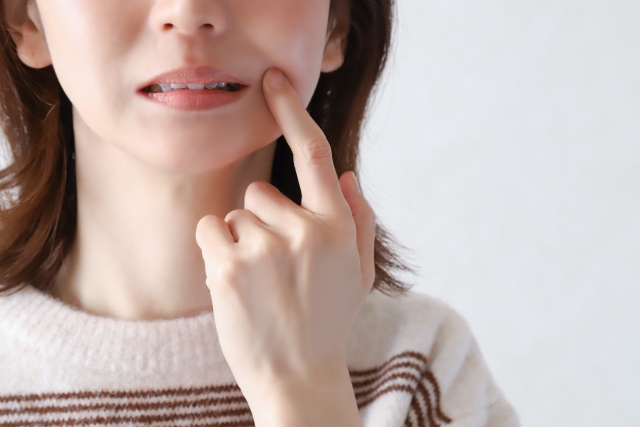
A recent TV program explained that misaligned teeth can make a person more prone to snoring.
In this article, we take a closer look at the relationship between dental alignment and snoring.
Ueno Snoring Clinic offers a range of options tailored to each patient’s condition, including insurance-covered sleep testing and CPAP management, as well as self-pay laser treatment for snoring. If you’d like to find out which treatment is right for you, please book an initial consultation.
Details of the tests and treatments offered at Ueno Snoring Clinic can be found here
Reviewed by Our Director
Reviewed by Our Director
Kazuyuki Sugaya
Director / Anesthesiologist, Ueno Snoring Clinic
With more than 20,000 general anesthesia cases, our director provides care centered on the diagnosis and treatment of snoring and sleep apnea, tailored to each patient. [Insurance-Covered] Ueno Snoring Clinic
This article has been medically reviewed by Director Kazuyuki Sugaya and explains accurate medical information about testing and treatment for snoring and sleep apnea syndrome (SAS) in plain language.
🩺Comprehensive Snoring Treatment at Ueno Snoring Clinic
The causes of snoring range from throat structure to obesity. Ueno Snoring Clinic is not limited to a single treatment method — we offer a wide range of evidence-based options so we can propose the plan best suited to each patient.
Thorough Testing & Ongoing Treatment (Insurance-Covered)
- Home sleep test / PSG (polysomnography): Precise analysis of your sleep condition
- CPAP therapy: The standard treatment for moderate-to-severe apnea
Self-Pay Treatment for Root-Cause, Short-Term Results
- Latest laser snoring treatment: Incision-free, root-cause treatment
- Medical weight-loss support: Physically opening the airway through weight reduction
*As a clinic specializing in snoring treatment, we are committed to resolving “snoring that won’t stop” through both insurance-covered and self-pay options.
Snoring, laser snoring treatment, sleep apnea, CPAP, Ueno Snoring Clinic
This topic is also covered in detail in our director’s book, “Curing Snoring with the Latest Treatments” (Amazon Japan Best Seller: #1 in General Medicine, #1 in Clinical Internal Medicine, #2 in Home Medical & Health)
New Book by Our Director
“Curing Snoring with the Latest Treatments”
Written by an anesthesiologist who has overseen the sleep of more than 10,000 patients, this book is a modern guide to the latest snoring treatments.
Quick Answer
Yes — dental alignment and jaw structure genuinely affect snoring. Misaligned teeth or a small/receded jaw reduce the space available for the tongue inside the mouth, making it more likely for the tongue base to collapse backward into the airway during sleep (tongue-base collapse). This is a well-established mechanism in sleep medicine, and it explains why some people snore heavily — or develop sleep apnea — despite being thin. Orthodontic treatment for tooth alignment alone doesn’t always resolve this; a sleep specialty evaluation is the recommended first step.
What This Article Covers
- The mechanism by which dental alignment and jaw structure affect snoring
- Types of dental/jaw structure most associated with snoring
- The risk of progression to sleep apnea syndrome
- Which specialty to see first
Do you assume your snoring is simply because you’re overweight, or “just something that comes with age”? In reality, sleep medicine has long recognized that dental alignment and jaw structure can be a significant, underlying cause of snoring.
At our clinic (Ueno Snoring Clinic), we regularly hear from patients who say, “My snoring didn’t improve even after orthodontic treatment,” or “I had an oral appliance made at a dental clinic, but I haven’t noticed a real difference.” In these cases, it becomes important to evaluate the root cause of the snoring from a sleep specialist’s perspective.
In this article, our director — a board-certified anesthesiologist with more than 20,000 general anesthesia cases and a specialist in airway management — explains the relationship between dental alignment and snoring in plain terms.
Why Does Dental Alignment Affect Snoring?
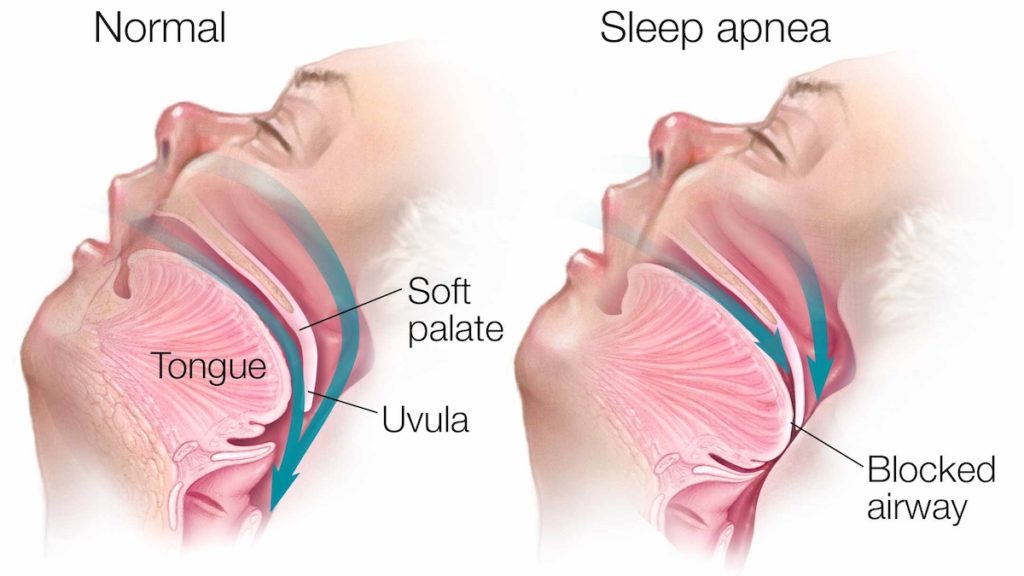
To begin with, how does snoring actually happen? During sleep, muscles throughout the body relax — including the soft tissue at the back of the throat (the tongue, soft palate, and uvula). This causes the airway to narrow, and with each breath, air passing through the narrowed passage causes the mucous membrane to vibrate, producing the sound we know as “snoring.”
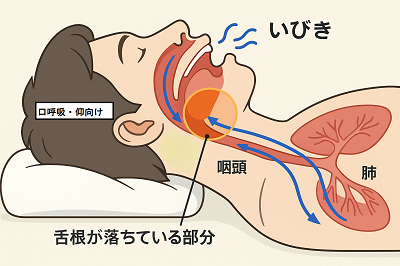
What matters here is the position of the tongue. Under normal conditions, the tongue rests comfortably against the upper palate inside the mouth. But when dental alignment or jaw structure is compromised, there isn’t enough space to keep the tongue in its proper position, making it more likely for the tongue base to fall backward into the airway during sleep — a phenomenon known as tongue-base collapse. This is one of the primary mechanisms behind snoring.
What Is Tongue-Base Collapse?
Tongue-base collapse occurs when the base of the tongue sinks backward into the throat during sleep, blocking the airway. It’s especially likely to occur when lying on your back, and is a major contributor to snoring and sleep apnea syndrome. People with poor dental alignment and limited tongue space have an oral environment that’s more prone to this collapse.
4 Dental/Jaw Types Associated With Snoring
Not every case of dental misalignment leads directly to snoring, but the following types are known to raise the risk.
| Type | Medical Term | Connection to Snoring |
|---|---|---|
| Protruding front teeth | Maxillary protrusion | Front teeth angled forward make it harder to close the lips fully, leading to mouth breathing. Sleeping with the mouth open makes the tongue more likely to fall backward. |
| Underbite | Mandibular protrusion / reverse bite | With the lower jaw positioned forward, the relationship between the jaw and airway shifts, and the soft palate tends to sit lower. |
| Small jaw | Micrognathia / retrognathia | A small jaw leaves less space for the tongue, making tongue-base collapse more likely. This bone-structure tendency is common among Japanese individuals. |
| Deep overbite | Deep bite | A deep bite between the upper and lower teeth compresses the space behind the tongue, narrowing the airway. |
Protruding Front Teeth (Maxillary Protrusion) and Snoring
With protruding front teeth, the upper front teeth are angled forward. This makes it difficult to fully close the lips, often leading to unconscious mouth breathing. Sleeping with the mouth open allows gravity to pull the tongue backward more easily, narrowing the airway. It can also dry out the mouth, irritating the throat lining and creating a vicious cycle that further worsens snoring.
Underbite (Mandibular Protrusion) and Snoring
With an underbite, where the lower jaw protrudes further forward than the upper jaw, the structural relationship between the jaw and the airway itself is altered. While the tongue being pushed forward might seem like it would create more airway space at first glance, the soft palate tends to sit lower in this structure, which can actually raise the risk of snoring.
Small Jaw / Receded Jaw and Snoring
Compared with Western populations, Japanese and other East Asian individuals tend to have smaller jaws and narrower airways. People with a small or receded jaw have structurally insufficient space to accommodate the tongue, meaning that simply lying down can be enough for the tongue base to press against and narrow the airway. This bone-structure background is a major reason why some people develop severe snoring or sleep apnea syndrome despite being thin.
A Common Trap: “Severe Despite Being Thin”
People with a small or receded jaw can experience severe sleep apnea syndrome even without being overweight. Assuming “I’m fine because I’m not overweight” can be a genuine mistake. Accurate diagnosis requires objective evaluation through proper testing.
Left Untreated, Snoring Can Become a Genuine Health Condition
Even when snoring is caused by dental alignment, leaving it untreated for a long period carries a real risk of progressing into sleep apnea syndrome (SAS) — a condition in which breathing repeatedly stops for 10 seconds or longer during sleep.
The impact of SAS extends far beyond reduced sleep quality.
- □ Strong daytime sleepiness and reduced concentration
- □ Increased risk of cardiovascular conditions including high blood pressure, arrhythmia, and heart failure
- □ A worsening cycle with diabetes and metabolic syndrome
- □ Increased risk of stroke and heart attack
- □ Reduced cognitive function
- □ Risk of falling asleep while driving or operating machinery
Dismissing snoring as “just noise” can, without realizing it, lay the groundwork for systemic health problems. This is especially true for people with dental or jaw issues, whose structurally narrow airway makes it worth seeking specialist evaluation early — even while snoring is the only symptom present.
Which Specialist Should You See First?
If you’re concerned about your dental alignment, you might assume “I should just go to an orthodontist.” However, for snoring and sleep-related concerns, the top priority is testing and diagnosis at a sleep specialty clinic first.
This is because appropriate treatment can’t be determined without an accurate evaluation of whether sleep apnea syndrome is present and how severe it is. Even when dental alignment is a contributing factor, it’s common for other factors — obesity, enlarged tonsils, nasal congestion, age-related muscle weakening — to be overlapping at the same time.
1. Visit a Sleep Specialty Clinic
We assess the overall picture through history-taking and physical examination, then objectively evaluate your sleep using insurance-covered testing.
2. Diagnosis via Home Sleep Test or PSG
A home sleep test, or a more detailed PSG, determines whether sleep apnea is present and how severe it is.
3. Choose a Treatment Based on the Underlying Cause
Based on your test results and the condition of your mouth and airway, we recommend a treatment plan best suited to you.
Testing at Ueno Snoring Clinic Is Insurance-Covered
Our clinic offers both home sleep testing and full polysomnography (PSG) under national health insurance. If you’re concerned about testing costs, please reach out to us first.
Our Strength: A Sleep Specialty Clinic Led by an Airway Management Expert
Ueno Snoring Clinic operates as a sleep specialty outpatient clinic in the Ueno and Taito-ku area of Tokyo.
Our defining feature is that we’re a specialty clinic focused specifically on diagnosing and treating snoring and sleep apnea syndrome.
Director Sugaya has more than 20,000 general anesthesia cases as an anesthesiologist, giving him deep expertise in airway structure and management. Because he’s intimately familiar with situations that require surgical airway control, he’s able to evaluate airway-related issues connected to snoring and sleep apnea from multiple angles.
If you’re concerned about snoring related to your dental alignment, have been told you have a small jaw, or were advised by an orthodontist to have your sleep evaluated first, we welcome you to reach out to us.
Medically Reviewed By: Kazuyuki Sugaya, Director
Director / Anesthesiologist, Ueno Snoring Clinic
An airway management specialist with more than 20,000 general anesthesia cases.
Author: “Curing Snoring with the Latest Treatments” (2026 edition, Creative Media Publishing)
Frequently Asked Questions
Conclusion
Here’s a summary of the relationship between dental alignment and snoring:
- □ Dental alignment and jaw structure directly affect the space available for the tongue, significantly influencing snoring
- □ Protruding front teeth, underbite, a small jaw, and deep overbite are all associated with elevated snoring risk
- □ Japanese individuals tend to have structurally narrower airways, so caution is warranted even for thin individuals
- □ Chronic snoring carries a real risk of progressing into sleep apnea syndrome and systemic health issues
- □ Testing and diagnosis at a sleep specialty clinic is the right first step
If you’ve ever wondered whether your dental alignment might be the reason you snore, it’s important not to ignore it — reach out to a specialist instead. At Ueno Snoring Clinic, we provide comprehensive, insurance-covered care from testing through treatment. Please feel free to contact us by LINE or phone.
Concerned Your Snoring Is Related to Your Teeth or Jaw?
Start With a Sleep Specialty Clinic
Ueno Snoring Clinic | Insurance-covered, from home sleep testing to full PSG
Our board-certified anesthesiologist evaluates your airway.
Hours: Weekdays & Saturdays, during clinic hours | Ueno, Taito-ku, Tokyo
[Insurance-Covered] If you’re concerned about snoring or sleep apnea, we offer a fully appointment-based system for reassuring, unhurried care.
Please feel free to contact Ueno Snoring Clinic [same-day appointments available]
📞0120-899-930
5F Ueno Silk Building, 4-8-8 Ueno, Taito-ku, Tokyo 110-0005, Japan

Please feel free to contact Ueno Snoring Clinic [same-day appointments available]
📞0120-899-930
5F Ueno Silk Building, 4-8-8 Ueno, Taito-ku, Tokyo 110-0005, Japan
Feel free to reach out to us on LINE ↓↓↓


English Support Available
We provide medical services for international patients. Please check our English website for details on how to visit our clinic.
Supervising Physician

Kazuyuki Sugaya, Director of Ueno Snoring Clinic
After graduating from Fujita Health University School of Medicine in 2004, Dr. Sugaya began his career as an anesthesiologist at Toho University Omori Medical Center. He has since gained extensive clinical experience at municipal hospitals and private clinics nationwide, administering general anesthesia in over 20,000 cases. In 2020, he founded the "Tokyo Spine Clinic," and has served as the Director of Ueno Snoring Clinic since 2025.
Related Columns


By Appointment Only
Specialized Snoring Treatment in Ueno
Ueno Snoring Clinic
Insurance-covered home testing available.
Following a physician’s consultation and result explanation,
we support the improvement of snoring and sleep apnea with "Dual Deep Thermia"—a non-surgical laser treatment, if necessary.
3-min walk from Ueno Station. Please feel free to consult us.